About Pour Over Brewing
Pour over makes the cleanest, brightest cup of any common home brew method. The paper filter strips out the oils and fine particles that French press lets through, which leaves a cup with sharper definition and a tea like clarity. The same clarity is honest about flaws. If your beans are stale, your grind is wrong, or your technique is sloppy, pour over will tell you. Most people who get into pour over end up improving every other brew method they touch.
The standard ratio sits between 1:15 and 1:17. A lot of specialty roasters ship single origin coffees with a 1:16 recipe card, and that is a fair starting point. Light roasts often shine at 1:16 to 1:17 because the higher water ratio gives floral and fruit notes more space. Medium and dark roasts tend to do better at 1:15 where the body comes through. One small adjustment at a time is the right approach.
V60, Chemex, and Kalita Wave are the three most common devices. The V60 drains fast through a single large hole and rewards an active pour technique. The Chemex uses a much thicker filter that slows the brew and produces an exceptionally clean cup. The Kalita Wave has a flat bottom with three small drain holes, which makes the extraction more even and is the most forgiving of the three for newcomers.
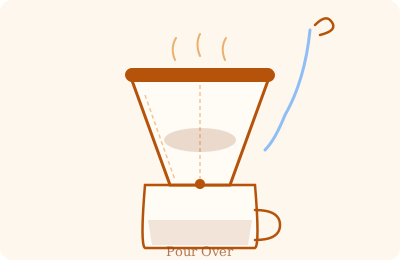
Pour Over Brewing Guide
The Bloom (Do Not Skip)
Pour twice the coffee weight in water over the grounds and wait 30 to 45 seconds. For 20g of coffee that is 40ml of water. The grounds will swell as carbon dioxide releases. Skipping the bloom in pour over leaves pockets of dry coffee that extract unevenly when you pour the rest of the water. The difference is more obvious here than in a French press because pour over is a percolation method, not full immersion.
Pouring Technique
After the bloom, add the rest of your water in two or three slow circular pours. Keep your pours steady and pour from low to avoid disturbing the grounds. A gooseneck kettle helps a lot here because you can control flow rate. Aim to keep the water level relatively stable in the cone, not flooding then waiting for it to drain completely between pours.
Total Brew Time
A 20g dose with 300ml of water should finish draining in 2:30 to 3:30 from the start of the bloom. Larger brews take a bit longer. Under 2 minutes means your grind is too coarse and water is bypassing the coffee. Over 4 minutes usually means too fine. Adjust grind size to hit your time target rather than changing how you pour.
Frequently Asked Questions
1:15 to 1:17 covers most setups. 1:16 (about 62.5g per liter) is a reliable starting point that works well across roast levels. Light roasts often taste better at 1:16 to 1:17 because that ratio highlights the brighter notes. Darker roasts at 1:15 produce more body and chocolate. Adjust by half a gram at a time once you have a baseline you like.
The bloom is a 30 to 45 second wait after wetting the grounds with twice their weight in water at the start. It lets trapped carbon dioxide escape so the rest of your pour can extract evenly. Roasted coffee contains gases from the roasting process that interfere with extraction if you do not let them out first. The difference is most obvious with beans roasted in the past two weeks.
Total brew time is 2:30 to 3:30 from first pour to last drip for a single cup recipe. Larger batches naturally take longer. If yours runs faster than 2:30, your grind is too coarse and the water is moving through too quickly. Slower than 4:00 usually means too fine or a clogged filter. Fix timing by adjusting the grinder, not by trying to pour differently.
They produce different cups. V60 is the most technique sensitive but capable of bright, complex extractions. Chemex uses a thick paper that absorbs more oils, giving the cleanest taste of the three. Kalita Wave has a flat bottom with three small holes that make extraction more even and forgiving. Beginners get more consistent results faster with a Kalita Wave. V60 rewards practice.
Medium to medium fine, similar to table sugar or a touch coarser. V60 typically wants medium fine. Chemex runs slightly coarser because the thick filter already slows things down. Kalita Wave sits between the two. If your brew runs too fast, grind finer next time. If too slow, go coarser. Adjust in small steps.
Sour means under extraction. Common causes are grind too coarse, water too cool, or pour too fast. Try a finer grind first. If that does not solve it, check your water temperature (should be 92 to 96 Celsius). Weak coffee without sourness usually means too little coffee for your water volume, so revisit your ratio before fiddling with technique.
It helps but is not strictly required. A gooseneck kettle gives you precise control over pour rate and where the water lands, which makes extraction more even. A regular kettle works but you have less precision. The kettle matters more for V60 (which is technique sensitive) than for Kalita Wave (which is more forgiving). If you are starting out, use what you have and upgrade later if you stick with the method.
Light roasts are denser and harder to extract, so they often need a slightly finer grind or a 1:16 to 1:17 ratio that gives the bean more water. Darker roasts are more porous and extract faster, so a slightly coarser grind or 1:15 to 1:16 works better. The difference in coffee dose is usually under a gram per cup, but it matters once you start tasting carefully.
The Coffee Ratio Team
We're coffee enthusiasts who built the most accurate brewing ratio calculator on the web. Our formulas are calibrated to Specialty Coffee Association (SCA) standards.